
10/14/2026 – Introduction by EduIssues Founder David Kristofferson:
I recently announced the possibility of an online debate here between the candidates in our upcoming election for the San Mateo Union High School District (SMUHSD) Area 3 Board of Trustees seat. The incumbent Jennifer Jacobson is running against challenger Diana Harris. Invitations were delivered to both candidates over a week ago. The debate format was to include a position paper from both candidates posted with neither candidate seeing the other’s document beforehand. These position papers were to be followed by one rebuttal post for each side. The rebuttals were not to be published until both were received by me. Blog comments were to be turned off on all posts. In the event that only one candidate agreed to participate, that candidate’s position paper would be posted and there would be no further posts from either one.
I am not endorsing either candidate but wished to provide both of them with an unfettered opportunity to present their views directly to the public and respond at length to each other. Other public events prior to this did not provide an opportunity for a discussion at length.
Jennifer Jacobson agreed to participate and sent me the position paper that follows this Introduction.
Diana Harris yesterday sent me a cordial email thanking me for the invitation but saying that “With the campaign in full swing, my schedule is stretched very thin, and unfortunately I’m not able to take part in a debate with my opponent on your blog.” She referenced her website www.votedianaharris.com as well as the BHNA candidate forum that I also linked to in my previous blog post.
According to the rules above, this will be the only post in this event.
My role was to write this Introduction, paste Jennifer Jacobson’s text into this WordPress blog post, check that the formatting in the WordPress software used here was correct, check that the hyperlinks were working, give the author a chance to review the text in WordPress prior to public release, and make any final edits requested by the candidate.
The following text below the separator line was written by Jennifer Jacobson.
First, my words are my own and I am not writing on behalf of the SMUSHD Board. I am writing as an incumbent candidate running for the Area 3 Trustee seat of the SMUHSD Governing Board. Comments or questions can be directed to me personally at info@jenniferjacobsonforsmuhsd.com.
As I’ve spoken to countless constituents over the course of this local campaign knocking on doors, at the Farmers’ Market, and other events, national politics never comes up. Most people would agree with David as he laments the politicization of public education. At the end of the day, I believe the purpose of public education is to provide young people with a solid foundation of the knowledge, skills, and character-development needed to be respectful, responsible adults who can function within and contribute to our society. This is what I benefitted from growing up in CA public schools and what I want for my own five children.
That said, as a government-funded institution, public education has a political element to it, especially in a “government of the people, by the people, for the people” (Gettysburg Address). Prior to the Constitution, the 1785 Land Ordinance set aside land for public schools and the Northwest Ordinance of 1787 identified knowledge as “necessary to good government and the happiness of mankind.” Together, these documents framed the federal priority that “schools and the means of education shall forever be encouraged.” As such, public education should prepare rising generations for the responsibilities and duties of citizenship within our nation. Our system of government as a democratic republic depends on individuals understanding the principles within our founding documents and governing themselves accordingly. A government-funded institution should promote the preservation of the very institution providing it.
The general public would find most of what we do at board meetings boring: approving agenda items like budgets, job descriptions, field trips, policy updates required by law, construction contracts, etc.; reporting on events or site visits we as board members have attended; and hearing reports from staff on topics ranging from curriculum/instruction, construction, human resources, business services, and student services. Over the course of my first term, my work on several of these topics has led to a track record of success. While I don’t take sole credit for every positive outcome, on my website I point out how I have personally driven, initiated or contributed to many of them, including:
- A districtwide phone-free school day policy
- New Career Technical Education courses & pathways, including dual-enrollment courses that earn college credit
- Real AI guidance for our district staff, students, and families
- Greater access to the data-driven student support program Empowerment Through Action
- Twice-yearly reading and math assessments across the district for 9th-10th graders
- A policy revision to better support students learning English and the educators who teach them
- A PE study hall option for student athletes
As I’ve spoken to local residents during this campaign, a few topics matter to most people across ages and stages of life. I will write about each of them below, plus a couple of the “controversial” ones my critics have raised.
College & Career Readiness
A diploma should mean something. It’s a reasonable expectation that when students graduate, they do so with a plan and ready for what’s next, whether it’s a two- or four-year college, a career, or skilled trade apprenticeship, military service, etc. In our district we have historically focused on college-prep, but college isn’t the path every student wants. Some people love working with their hands, but we have largely done away with shop classes. I am endorsed by the Carpenters Union, and when I visited their training facility in Pleasanton, I learned that the average age someone starts as an apprentice is 27. What have they been doing since age 18? Ideally our students can take a hands-on course like our Construction Trades course, get an industry credential, and begin a skilled trade apprenticeship right out of high school with a starting wage of $40+/hour. Approved during my time on the Board, this course is the only one like it in the county, and more students should be able to access it.
We need pathways to successful careers for students who want to earn more than minimum wage or who want to work within their field while pursuing higher education. I have been beating this drum steadily during my first term, and thankfully we now have multi-year career pathways in more industries than ever: biotech, business, healthcare, interior design, architecture, engineering, computer science, hospitality, and more. Next, staff need to help students find room in their schedules to take them earlier so they can complete a multi-year pathway before graduation. Career Technical Education (CTE) should not be stigmatized, nor should it impose barriers for students seeking college admissions. Many CTE classes are dual-enrollment, meaning students can earn college credit for them while still in high school. This is not an “either-or.” It is a “yes-and.” CTE benefits all kinds of students.
We also need to keep the academic rigor at a level that prepares students for college-level coursework. Unlike other districts on the Peninsula, we haven’t eliminated honors or AP classes. Students should be challenged at the level they are ready for, and given extra support when they don’t meet grade-level proficiency.
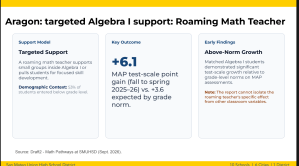
Before my time on the Board, we had only one districtwide measure of academic proficiency, aside from grades: the state CAASPP test at the end of 11th grade. Results from this test were always presented with the disclaimer that students don’t take the test seriously, so we can’t really take the results seriously. As the saying about data goes, “garbage in, garbage out,” and our data wasn’t telling us what we needed to know to inform intervention. I requested districtwide common assessments in math and reading. Now 9th and 10th-grade students are assessed twice a year using the NWEA MAP assessments (Measures of Academic Progress). This way we can compare data across sites and learn what interventions are working. For example, Aragon introduced “roaming” Algebra 1 teachers who pull students out of class as needed to give 1:1 or small group instruction. The idea sounded promising, but there was no system for measuring it. Using the MAP data, we learned matched Algebra I students demonstrated significant test-scale growth relative to grade-level norms on MAP assessments compared to their peers. (Spotlight on Student Learning Presentation, slide 28) In other words, the data suggested the intervention was working, and students were growing faster than expected in math.
Phone-Free Schools
When the state of CA passed a law requiring all school districts to create a policy restricting mobile devices during the school day, SMUSHD faced a choice. Do we codify our current practice of teachers telling students to place their phones in a classroom cubby during each class, or do we lock them up in pouches all day as San Mateo High School has been successfully doing for years? I joined the working group of students, parents, and teachers to study the issue, including the latest research, storage options, and practices in other districts. At the end of a months-long process, I was surprised that this group easily came to the consensus that our students would be best served by a full-day device restriction, or “bell-to-bell” policy, and I strongly advocated for it in our board meetings. Following a survey to all parents, students, and teachers, we learned over 60% of teachers favored a bell-to-bell policy. Even though administrators initially resisted, the community rallied and the Board unanimously voted for a phone-free school day.
It has proven to be a good choice for our students. At our October 8th Board Meeting, staff reported on the implementation now that we are two-months in. While there are some minor issues–to be expected with any new major policy shift–the rollout has been smooth overall and staff are seeing positive outcomes:
- Students are connecting more face to face with their peers and their teachers
- Students are more focused in class
- Fewer trips to the bathroom during instruction time
- 50% lower suspensions at Mills High School
- More participation in clubs at lunch
- More food eaten at brunch/lunch
- Number of phones connected to school WiFi during peak hours went from 200+ per campus to 15-25 per campus.
Jesse Boise, Assistant Principal at Hillsdale, thanked the Board for taking a risk and declared, “I can’t imagine going to school another way.”
Artificial Intelligence in Education
Chat GPT released its first major LLM during my first year on the Board. This event has rapidly changed many aspects of our lives, including education. Over the last decade, and especially through the pandemic, schools have leaned into “EdTech” products. More recently some researchers are questioning the efficacy of these tools, while others think AI should transform K-12 education.
It seemed prudent to me to examine our overall technology usage and strategy. As a result, the Board directed the district to convene an AI Task Force, and I was the only trustee to sit on it. A variety of stakeholders attended: students, staff, and community members–some of whom were parents of students in the district, others work in tech. The question “What should artificial intelligence never replace?” framed our discussion. We discussed many hopes and fears, and if you watch the movie The AI Doc: Or How I Became an Apocaloptimist you’ll know what I’m talking about. We hope AI can be a means to remove barriers and customize learning in ways that meet students where they are and challenge and support them accordingly. Teachers worry about academic integrity, undetected bias within AI models, and students losing the “productive struggle” that learning requires. Parents worry about safety and the social, emotional, and academic development of their children. Students worry about being prepared to find a job when AI is changing the career landscape so quickly.
We all recognize the capacity artificial intelligence has to save time, increase productivity, eliminate busywork, and augment human effort, but what about when human effort is the outcome sought? Teachers don’t want essays on Romeo and Juliet generated by a cleverly worded prompt and later tweaked with errors to elude AI detectors. They want students who can read and comprehend an entire novel, identify rhetorical devices and themes, analyze a character’s motivation and actions, and use the English language to articulate their ideas. While AI can in some ways support these learning objectives, it cannot make a student the kind of reader, writer, or thinker capable of evaluating the AI output. That is the collaborative job of teachers and students together.
Deliverables from the Task Force included a vision and principles statement for how AI fits into our human-centered institution and guidance for district staff, parents, and students going forward. Before the 2026-2027 school year started, every teacher was asked to include specific expectations in each course syllabus regarding AI use. Further, the Board also approved a no personal device policy in alignment with our phone-free policy. This creates a “walled garden” on campus where students can use technology within the defined boundaries of their school-issued chromebooks while connected to the district network, without accessing restricted sites. If students could bring personal laptops to school as they had in the past, it would continue to be an equity issue.
The AI Task Force continues this year, and teachers will continue to need more granular guidance when it comes to instructional design and strategies to assess student mastery of knowledge and skills.
Ethnic Studies
AB101 required a single-semester ethnic studies course to be a graduation requirement beginning with the class of 2030. The SMUHSD Board approved the course and graduation requirement before my time on the board and ahead of AB101. This course has been the subject of controversy throughout the state of CA, so it is no surprise that there would be some controversy about it within our own district.
Proponents praise the course for its inclusivity, for increasing student engagement, for helping more students of color see themselves in the curriculum, and for telling their untold stories. Critics focus on the ideological lens it introduces.
According to SMUHSD’s Ethnic Studies Curriculum Guide, the course explicitly centers on themes of intersectional identity, unequal power relationships, privilege, and systemic oppression. It frames historical and contemporary society in terms of dominant and historically marginalized groups, and it requires students to analyze multiple forms of oppression. The guide also explicitly promotes social justice, civic participation, grassroots advocacy, and action to dismantle systems of oppression and create a more equal society. It emphasizes lived experience, the social construction of racial and ethnic categories, and students as co-constructors of knowledge.
Related, and also before my time on the Board, the social science department took steps to re-orient the entire social science sequence toward these ethnic studies themes, emphasizing structural power, privilege, marginalization, and the ways institutions can perpetuate inequality. The 10th grade Modern World History and 11th grade US History courses of study were re-written to de-emphasize Western political thought and the “Narrow Eurocentric Lens of Historiography.” (Board Meeting, March 11, 2021)
I attend district professional development days and have been present in multiple workshops where educators demonstrate how Ethnic Studies themes can be extended to other subjects, even the “non-partisan” ones like math and science that David Kristofferson praised as being unbiased. I oppose this type of academic mission creep.
How does Ethnic Studies relate to antisemitism? Some of the main “tenets” of Ethnic Studies are decolonialization and Third World solidarity. These themes are fertile ground for a narrative in which the modern state of Israel being a “settler-colonial” project of White Europeans and oppressive to the Palestinian people who are the rightful indigenous people of that land. In their letter to the UC Board of Regents on October 16, 2023, UC Ethnic Studies professors claimed the Board was wrong to call the October 7 attacks on civilians an act of “terror” because “to hold the oppressed accountable for ‘terrorism’ reinscribes a colonial narrative.” They called on the UC administrative leadership “to retract its charges of terrorism, to uplift the Palestinian freedom struggle, and to stand against Israel’s war crimes against and ethnic cleansing and genocide of the Palestinian people.”
Whether or not you agree with calling the October 7 massacre a “freedom struggle” or the subsequent attacks in Gaza a “genocide,” one can see how this framing, aligned to an ethnic studies lens, can easily give way to antisemitism. It has in other districts, inviting lawsuits and settlements. Last year, CA passed AB 715 which strengthens anti-discrimination protections in K-12 public schools and establishes a framework focused on preventing antisemitism and other forms of bias. Thankfully, to my knowledge, the course content in our district has not crossed that line during my time on the board. Though many CPRA (California Public Records Act) requests have been filed and hundreds of course documents produced, they have not resulted in a lawsuit. From time to time posters are hung in classrooms that don’t belong there, and when they are, the Superintendent takes prompt action. That said, as I mentioned earlier, the framework presented in Ethnic Studies based on power and privilege lays the groundwork for certain narratives to flourish.
During my first year on the Board, we received hundreds of emails from constituents sent through an advocacy group with concerns over ideological content in the Ethnic Studies course and the professional development provider. We also received many emails from community members, including teachers, praising the course and the training they had received from the provider and from district personnel. The district held a study session in response. Following that, the PD contract was not renewed. In an effort to provide greater transparency to course content, the superintendent directed teachers to create a curriculum guide with sample lesson plans and coursework from across our sites.
As a parent watching my daughters take these courses in real time, I observed all these adjustments to the social science courses and had some concerns of my own, including major historical events that were excluded and certain activities that seemed overly political. In February 2025 I accepted the invitation to speak at an online statewide Ethnic Studies Forum. Most of the speakers were students or parents of students who had encountered antisemitic content as part of their Ethnic Studies or history lessons or experienced antisemitism at school. I informed the audience of Board Policy 6144, which most districts in CA have adopted and outlines how teachers are to handle controversial issues, and what to do if biased or inappropriate content is presented in class.
That forum was a moment where I was speaking as a parent, in a parent context, and I later recognized I should have been clear about that distinction when identifying myself in a non-district, public setting. I met with the District Teachers’ Association president afterward, we talked it through honestly, and we’ve had a good working relationship since.
Personally, I believe Ethnic Studies is best-suited for senior year, after students have learned the facts of the events of modern world and US history with a neutral framing rather than having the Ethnic Studies lens applied. Having that foundational knowledge and added maturity would lend more nuance and rigor to the course, in my opinion. Others would argue that placing Ethnic Studies in 9th grade is a feature, not a bug, precisely because it frames the rest of the social science sequence and introduces a lens and set of vocabulary to be referenced in other courses.
Safe & Connected Schools
I care deeply about all people. I have a special concern for young people who are vulnerable to bullying, harassment, or exclusion for any reason. I sincerely believe every person deserves to be treated with dignity and respect. All students and staff deserve to be physically safe and respected within their school community, and to learn and work in an environment free from bullying, harassment or discrimination.
During my time on the board the district has made efforts to improve the culture on campus with the intent to protect those who face dehumanizing language or targeting based on race, immigration status, sexual orientation, gender identity, etc.
I have already discussed my perspective on the district’s approach to anti-racism here.
In September 2025, our Board unanimously approved an emergency response protocol for situations where unidentified individuals come onto a campus and try to remove a student, parent, or staff member without proper identification or a judicial warrant. The goal is to slow the situation down, keep everyone isolated and safe, and bring in district leadership. It’s one of the ways we’re working to make sure every student and family feels safe and supported at school.
In the September 10, 2025 board meeting, we had a discussion about a board policy outlining practices to support transgender and gender-nonconforming students. I asked for more time to review that policy because I wanted to fully understand what was changing before voting on it — and I wasn’t the only one. Other trustees and several community members, including one of our own teachers, raised similar questions about parental notification practices. If I had to do it over again, I would have chosen different words to express myself. Some people took offense to my questions and comments although none was intended. Others have taken my words and twisted them. I’m not “anti-trans,” I never called LGBTQ+ people a “contagion” or said we support them “too much.” These are lies. They are not true. They are mischaracterizations of a nuanced argument I made, which is my job as a trustee. Adults should know the difference. My whole statement is available in the public record.
In the end, I voted yes because I believe in preventing bullying and complying with the law, even where I had reservations on points of tension between competing rights of safety, inclusion, privacy, and free speech. That’s what thoughtful governance looks like — asking hard questions, listening to the community, and still being able to reach a decision. Since then I have done more learning on the topic as I’ve engaged with more families with LGBTQ+ youth.
Respectful Discussion
During my time on the board, I learned that some students censor their own speech to avoid social consequences. In order to quantify this tendency, I proposed adding questions about it to the annual SMUHSD student survey on school climate. It turns out only 32% of students feel comfortable expressing views on controversial topics in class, and 67% feel they can’t share an opinion for fear of how it will be received.
School should be the place where young people are free to ask questions to discover the world and to form their viewpoints through open inquiry and civil discourse. This is how genuine consensus can be achieved, rather than through fear and intimidation. Applying labels to certain ideas and to people who express them creates conflict, stifles expression, and limits learning. In extreme cases, it leads to violence.
The Foundation for Individual Rights & Expression tracks free speech on college campuses. In a grim coincidence, FIRE released new findings after a shooting on a college campus, and they were chilling. In 2020, 1 in 5 students said violence was acceptable to stop a speaker from speaking on campus. In 2025, that number is 1 in 3. That’s a 79% increase in just five years. This trend is true on both sides of the political spectrum. 1 in 3 hold some level of acceptance for using violence to stop a speaker. Of note, these are college students–which means that they were recently high school students, and that they were educated well enough to get into college. And yet, they believe violence is justified to stop someone from saying words they don’t like. This is truly alarming. We’ve now seen what happens when such violence is carried out under such a permission structure.
As adults we need to model this better for our kids. In January 2024 we updated BP 1313 on Civility to reflect our commitment to civil discourse. I am willing to listen to anyone on any topic, because when I do, I learn. I have deep respect for people with that attitude. When I hear something negative about another person, or encounter new information that raises questions, I believe the best course of action is to ask whether there’s more to the story. These conversations are best held face to face, not keyboard to keyboard.
Final Remarks
Few candidates tick all the boxes on every issue, and every individual must weigh what issues matter most to them. I hope this post helps you do that.
A vote for me doesn’t mean you agree with everything I do or say. It means you believe the Board as a whole would continue to benefit from including a person who is experienced with the job at hand, willing to ask hard questions, listen to varying viewpoints while pursuing what is best for kids, work collaboratively with others, and be willing to reconsider my stance when I encounter new information. It also means you see the work I’ve done so far and trust that it represents the level of preparation, dedication, and commitment I have to pushing this district forward in a positive way.


